Latex Balloons and EN 71 Standards Explained | Everts-Pol
Key information:
- Latex balloon safety and documentation
- Toy safety legislation – what currently applies?
- Which EN 71 standards are relevant to latex balloons?
- What does the SGS Institut Fresenius report confirm?
- Test reports, EN 71, declarations of conformity and CE marking – what is the difference?
- Why should you check balloon documentation?
- Documentation and manufacturer responsibilities at Everts-Pol
- Frequently asked questions – FAQ
Latex balloon safety and documentation
The safety of latex balloons cannot be established by CE marking alone or by a single laboratory test. For products placed on the market as toys, relevant factors include a safety assessment, technical documentation, an appropriate conformity assessment procedure, testing, and the required markings and warnings. Everts-Pol is a Polish manufacturer of latex balloons. Our product documentation also includes laboratory test results relating to specific safety requirements. In this article, we explain what the EN 71 standards are, exactly what the SGS report presented here confirms, and how laboratory testing, a declaration of conformity, CE marking and a certificate differ.Toy safety legislation – what currently applies?
In 2026, the main legislation governing the placing of toys on the European Union market remains Directive 2009/48/EC on the safety of toys. Under EU law, a toy is a product designed or intended, whether or not exclusively, for use in play by children under 14 years of age. A particular product should therefore be classified according to its intended use, rather than solely by the material from which it is made. A toy manufacturer is responsible for, among other things:- carrying out a product safety assessment,
- applying the appropriate conformity assessment procedure,
- preparing technical documentation,
- drawing up an EU declaration of conformity where required,
- providing the required markings, instructions and warnings,
- ensuring that manufactured products conform to the documentation for the particular product.
Which EN 71 standards are relevant to latex balloons?
The EN 71 series comprises European standards addressing different aspects of toy safety. It is not a single “EN 71 certificate”. Individual parts cover different properties and test methods.- EN 71-1:2014+A1:2018 – Mechanical and physical properties This standard addresses the mechanical and physical aspects of toy safety and includes requirements for certain warnings. For latex balloons, information about the risk of choking or suffocation from uninflated and broken balloons is particularly important.
- EN 71-2:2020 – Flammability This standard specifies flammability requirements for materials used in toys. However, meeting the relevant flammability requirements does not mean that balloons should be placed near candles, open flames or other ignition sources.
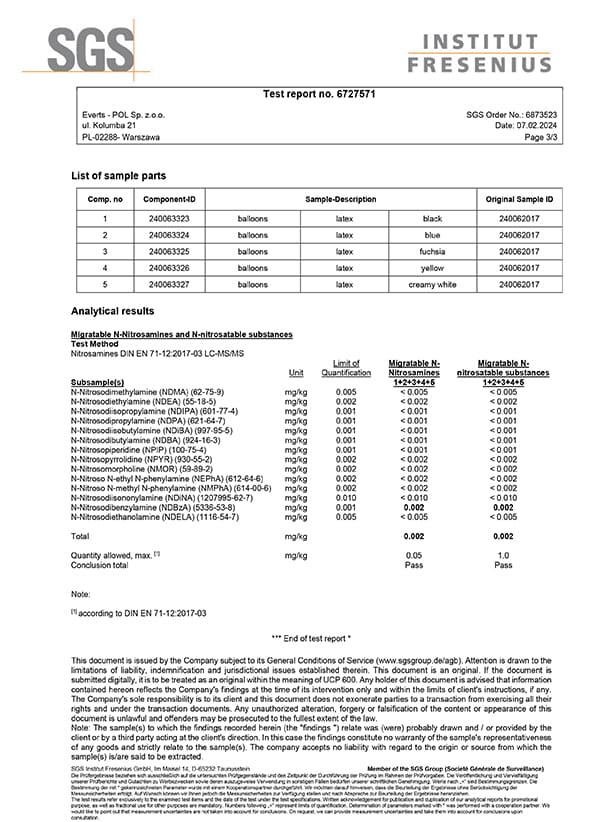
- EN 71-12:2016 – N-nitrosamines and N-nitrosatable substances This part of the standard specifies requirements and test methods for N-nitrosamines and N-nitrosatable substances in certain elastomer toys, including balloons. The standard specifies limit values and testing procedures. Test results should always be interpreted in relation to the specific sample, method and assessment criteria used in the report.
What does the SGS Institut Fresenius report confirm?
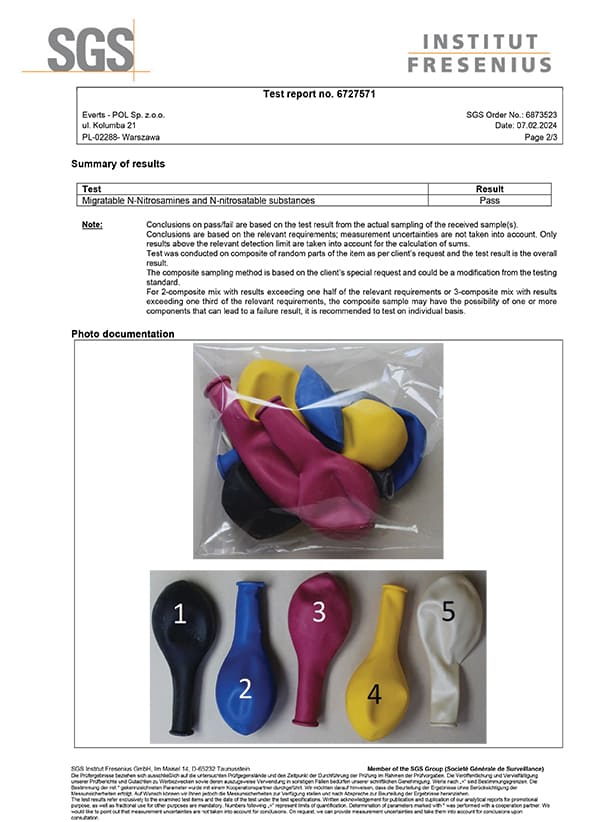
This page presents SGS Institut Fresenius GmbH test report no. 6727571, dated 7 February 2024. The sample is described in the report as: “Balloons Mix – Standard, Metallic, Macaron, Chrome”. The testing covered N-nitrosamines and N-nitrosatable substances and was carried out according to DIN EN 71-12:2017-03, the German version of EN 71-12:2016. The overall test result stated in the report is: “Pass”. This means that the tested sample met the criteria specified for the scope and method used in that particular test. The document presented is a laboratory test report, not a product certificate. It should also not be interpreted as confirmation that all possible requirements of the EN 71 series have been met.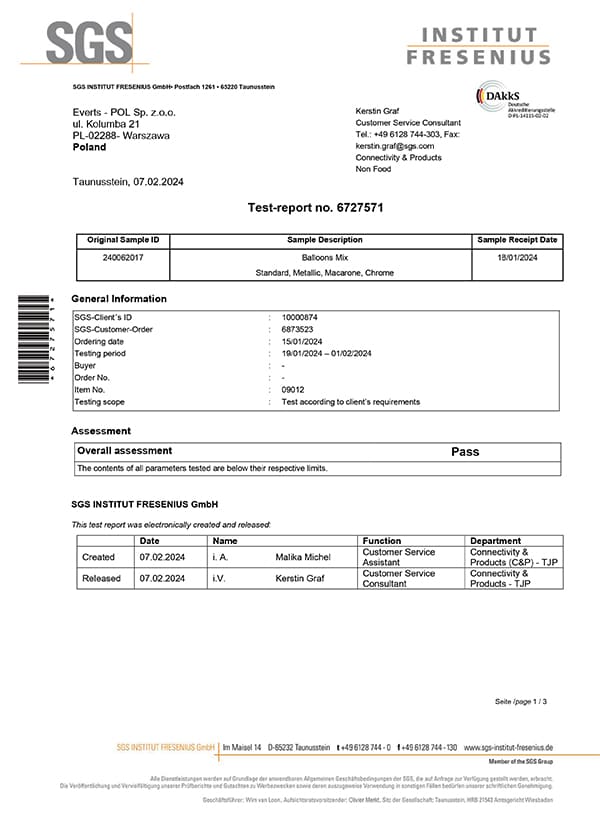
What should you check in a test report?
- the laboratory name,
- the report number,
- the test date,
- the description of the tested sample,
- the scope of testing,
- the method or standard used,
- the results and final assessment.
Test reports, EN 71, declarations of conformity and CE marking – what is the difference?
These terms are often used interchangeably, although they refer to different elements of the conformity assessment system.| Term | What does it mean? |
|---|---|
| Test report | Documents the tested sample, the scope and method of testing, and the results obtained. |
| EN 71 standard | Specifies requirements and/or test methods for particular aspects of toy safety. |
| EU declaration of conformity | A document in which the manufacturer declares that the product meets the applicable requirements of EU legislation. |
| CE marking | A marking associated with the manufacturer’s declaration that the product complies with applicable EU requirements. CE is not a quality certificate or “product approval by the European Union”. |
| EU / EC-type examination certificate | A document associated with a specific conformity assessment procedure involving a notified body. Not every laboratory report is this type of certificate. |
Why should you check balloon documentation before purchasing?
Access to documentation is particularly important for professional buyers who need to assess a product before offering it for sale or using it in their business. Before purchasing, check:- who manufactures or imports the product,
- which legislation applies to the product,
- whether the appropriate declaration of conformity is available,
- which tests have been carried out and exactly what they covered,
- whether the product has the required markings, instructions and warnings,
- whether the documentation corresponds to the product currently being offered.
Documentation and manufacturer responsibilities at Everts-Pol
Everts-Pol is a Polish manufacturer of latex balloons. As the manufacturer, we are responsible for assessing the conformity of our products, preparing the required technical documentation and providing the appropriate markings and warnings. Laboratory test results form one part of the documentation used in this process. When communicating about product safety, we therefore specify the scope of testing rather than using the term “certificate” as general confirmation of all balloon properties. If you need information about the documentation for a specific Everts-Pol product, contact us. To learn more about CE marking, see: what does the CE marking on latex balloon packaging mean?Frequently asked questions – FAQ
Are all latex balloons classified as toys?
This cannot be assumed solely on the basis of the product’s material or form. Under EU law, a toy is a product designed or intended, whether or not exclusively, for use in play by children under 14 years of age. A particular product should therefore be classified according to its intended use.
Is EN 71 a certificate?
No. EN 71 is a series of European toy safety standards. These standards specify requirements and test methods for individual aspects of safety. A report confirming testing according to a particular part of EN 71 is not automatically a product certificate.
What exactly does EN 71-12 cover for balloons?
EN 71-12 specifies requirements and test methods for N-nitrosamines and N-nitrosatable substances in products including elastomer balloons. SGS report no. 6727571, provided by Everts-Pol, documents testing within this scope, with a “Pass” result.
What does a “Pass” result in an SGS report mean?
It means that the tested sample met the criteria applied to the scope and method used in that particular test. A “Pass” result should not be interpreted as confirmation of every possible product property or compliance with every part of the EN 71 series.
Is the SGS report a product certificate?
No. The document presented by Everts-Pol is a report on a specific laboratory test. It contains information about the sample, testing scope, method used and results. It should not be described as a general product certificate.
Do Everts-Pol balloons carry CE marking?
Everts-Pol balloons covered by the appropriate declaration of conformity carry CE marking. CE marking means that the manufacturer declares the product’s conformity with the applicable requirements of EU legislation. It is not a quality certificate or product approval by an institution of the European Union.
Is a laboratory report alone sufficient to affix CE marking?
A single report should not be equated with the entire conformity assessment process. The manufacturer must identify the requirements applicable to the product, carry out an appropriate safety assessment and conformity assessment procedure, and prepare the required documentation. Test results may form part of that documentation.
What should you look for when checking balloon documentation?
Check who manufactures or imports the product, which requirements apply, whether the appropriate declaration of conformity is available, which tests have been carried out, and whether the product has the required markings and warnings. The country of manufacture alone does not determine product compliance.