DIY First Communion Balloon Garland: Guide | Everts-Pol
Key information:
- Why create a balloon garland for First Holy Communion?
- Which latex balloons should you choose for a First Communion garland?
- Types of balloon garlands – classic or organic?
- What do you need to make a balloon garland?
- How to make a balloon garland step by step
- How to create the irregular shape of an organic balloon garland
- Personalising your garland – printed balloons and logo balloons
- First Communion balloon garland ideas – inspiration and arrangements
- Practical tips for making a balloon garland
- Common balloon garland mistakes and how to avoid them
- Which Everts-Pol balloons can you use in a garland?
- FAQ – frequently asked questions
Why create a balloon garland for First Holy Communion?
First Holy Communion is an occasion when decorations in a venue, home or garden can create a coordinated setting for the table, entrance area and family photographs. A balloon garland is one way to achieve this and can be adapted to both a small celebration at home and a larger venue. A balloon garland is an arrangement of connected balloons that can be installed above a table, around an entrance or alongside a photo backdrop. Depending on the design, it can have a regular pattern or a more irregular, organic shape. You can make a simple garland yourself using a pump, balloon garland tape and suitably chosen balloons. In this guide, we explain step by step how to plan a First Communion balloon garland, which balloon sizes to choose, what to use for installation and how to complete the arrangement with smaller balloons and printed balloons. You will also find tips on planning your colour palette, installation and common mistakes. These will help you adapt the decorations to the size of your space and your vision for the celebration.Which latex balloons should you choose for a First Communion garland?
When choosing balloons for a garland, the main considerations are size, colour, finish and the quantity needed for your planned arrangement. For organic garlands, using several sizes is helpful: larger balloons create the main volume, while smaller ones fill the gaps. Everts-Pol manufactures latex balloons in Poland. You can combine different sizes in a garland, such as EV13 5″ balloons for smaller fillers, EV27 11″ or EV30 12″ balloons for the main structure, and EV45 18″ balloons for larger accents. The choice of sizes depends on the length and style of the particular garland. Recommended balloon sizes and types for a First Communion garland:- EV13 5″ (approx. 12.5 cm) – for filling gaps between larger balloons.
- EV27 11″ (approx. 27 cm) or EV30 12″ (approx. 30 cm) – for the main elements of the garland.
- EV45 18″ (approx. 45 cm) – for larger accents at selected points in the arrangement.
You can complement the garland with a few personalised printed balloons. Everts-Pol offers a white First Communion balloon featuring the Polish wording “Pierwsza Komunia Święta” (“First Holy Communion”), the child’s name and a praying hands motif.
Types of balloon garlands – classic or organic?
Two popular approaches to arranging balloons are the more regular classic garland and the irregular organic garland.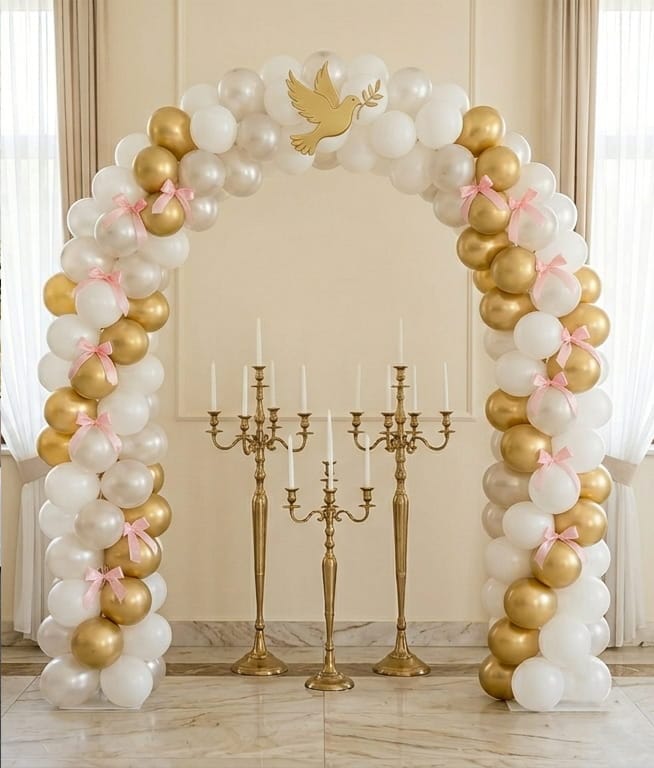
A classic garland features a more regular arrangement and a repeating rhythm of balloons. It can be used, for example, above a communion table, near an entrance, or in a narrower space.
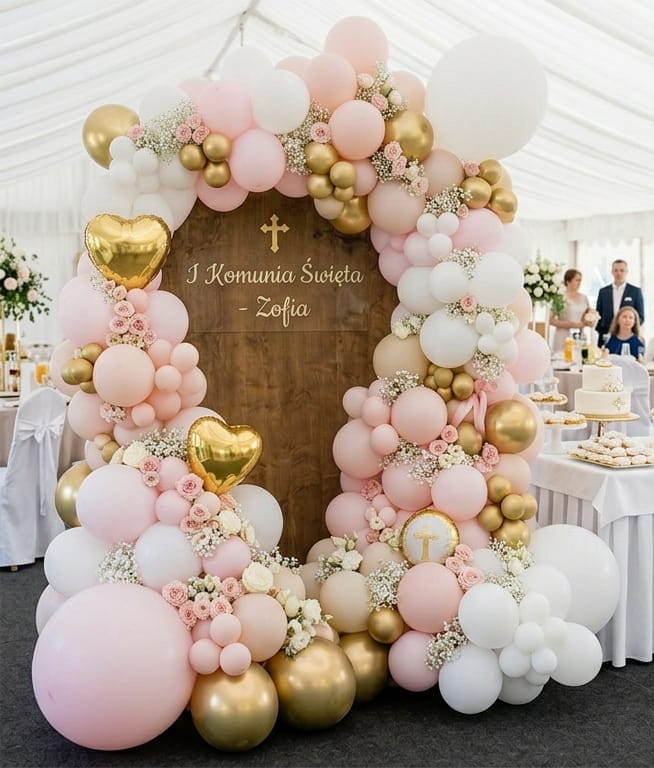
An organic garland uses balloons of various sizes arranged in an intentionally irregular pattern. Smaller balloons are used, among other things, to fill the spaces between larger elements. In this context, the term „organic” describes the style of the composition, rather than the properties of the material or any environmental benefit.
For a First Communion, you could use an organic balloon garland—for example, in white, ecru, and gold—complemented by touches of soft pink, light blue, or another shade that coordinates with the venue’s decor.
What do you need to make a balloon garland?
The following list provides a starting point for making a garland approximately 3–4 m long. The exact number of balloons depends on their sizes, the density of the arrangement and the number of smaller balloons used to fill gaps:- Latex balloons in several sizes, such as EV13, EV27/EV30 and EV45 – available in our online shop at www.everts-pol.pl
- Balloon garland tape – 5 metres
- An electric or hand balloon pump
- String, fishing line or another fastening option suited to your installation method
- Glue, double-sided tape or glue dots
- Accessories: eucalyptus, artificial flowers for First Communion decorations, satin ribbons and battery-powered LED lights
How to make a balloon garland step by step
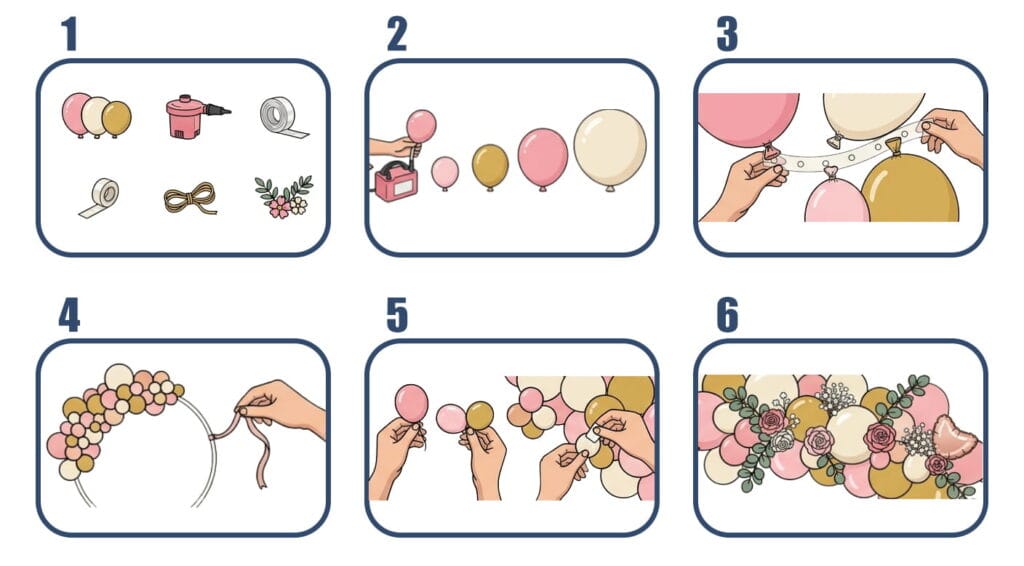
- Step 1: Measure the space and plan your garland. Measure the intended length of the decoration and decide whether you want a looser or denser arrangement. Choose the number of balloons according to their sizes and the planned density. Prepare a few extra balloons as spares. Gather your balloons, pump, balloon garland tape, fastening materials and planned decorative accessories.
- Step 2: Inflate the balloons. Prepare balloons in your chosen sizes. Do not exceed the recommended size for each product, and aim for consistent sizing among balloons serving the same purpose in the arrangement.
- Step 3: Build the base. Insert the tied balloon necks into the holes in the garland tape, gradually arranging the colours and main balloon sizes.
- Step 4: Install the base in its intended position. Secure the garland to a stable anchor point or suitable frame. Choose a fastening method appropriate for the surface, length and weight of the decoration.
- Step 5: Fill the gaps. Once the base is installed, view the arrangement from the front and add smaller balloons wherever extra filling is needed.
- Step 6: Add decorative elements. If included in your design, add ribbons, lightweight floral elements or other accessories. Make sure sharp ends do not come into direct contact with the balloons.
How to create the irregular shape of an organic balloon garland
For an organic garland, start by building a base with medium and larger balloons, then fill the gaps with smaller balloons. Varying the balloon diameters creates an irregular structure and adds depth to the arrangement.- Personalising your garland – Personalised balloons can serve as individual accents within a garland. You do not need to make the entire decoration from printed balloons – place a few in clearly visible positions. Everts-Pol offers white balloons featuring the Polish wording “Pierwsza Komunia Święta” (“First Holy Communion”) printed in gold, personalised with the child’s name.
Practical tips for making a balloon garland
When making your first garland, the main challenges are usually choosing the right number of balloons, maintaining proportions and securing the arrangement. The following tips can help reduce these difficulties.Should you use a balloon sealant?
Some products designed for latex balloons can also be used with air-filled balloons. If you use such a product, follow the manufacturer’s application and dosage instructions. A sealant is not essential for making a garland.Watch out for jewellery and sharp objects
Before assembling the garland, remove rings or other items that could catch on the balloon surface. Gloves are optional if they make the work easier.Build the garland in layers – from the base to a “cloud” effect
Start with a main base of larger and medium-sized balloons, then fill the gaps with smaller EV13 balloons. In an organic garland, small balloons do not need to be spaced perfectly evenly.Plan your colour palette before you start
A simple approach for First Communion decorations is to choose a base colour and one or two complementary colours, such as white with ecru and a gold accent. You can use more colours if they form part of a coordinated design.Add LED lighting during assembly
If you use LED lights, choose a product suitable for the intended location and install it according to the manufacturer’s instructions. Avoid light sources and components that can become very hot.Insert floral accessories, such as eucalyptus and flowers, between the balloon layers
Lightweight floral elements can be added between the balloons once the main structure is complete. Cover sharp ends on stems, wires and other components so they do not damage the balloon surfaces.Prepare a sample section of the garland
Before making the entire garland, prepare a small sample section. This allows you to check the colour combination, balloon sizes and placement.Choose fixings suited to the structure
Balloon garland tape connects the balloons, while the method used to secure the entire decoration should take into account its length, weight, the mounting surface and the specifications of the hooks, frame or other fixing components.Plan your assembly schedule
Protect the finished decoration from direct sunlight, high temperatures, sharp objects and heat sources. How far in advance you can prepare the garland depends on the conditions and how the decoration is made.
Personalise your garland with printed balloons and logo balloons
Use printed balloons as accents. Choose their quantity according to the size and layout of the garland so that the print remains clearly visible.Consider safety during assembly and after the celebration
Inflate and use balloons according to the information on the packaging. Children under eight should be supervised by an adult. Keep uninflated balloons out of their reach and remove broken balloons and their pieces immediately. After the event, collect the remaining decorations and dispose of them according to local waste management rules. When making a garland yourself, the most important steps are measuring the space beforehand, preparing enough balloons, planning the colour palette and securing the display properly. For your first project, start with a simpler arrangement and add smaller elements once the base is installed.Common balloon garland mistakes and how to avoid them
When making your first balloon garland, it is easy to misjudge the number of balloons, overinflate them or choose unsuitable fixings. Below, we explain the most common problems and how to reduce them.Overinflating balloons
Do not exceed the recommended size for the specific balloon model. Overinflation increases tension in the material and may also alter the balloon shape intended for your arrangement.Not planning a coordinated colour palette
Choose your main colour palette before buying balloons. For a First Communion celebration, you could use white as a base and complement it with ecru, gold, pale pink or light blue. If you plan to use more colours, test the combination beforehand. For the most consistent shade throughout your decoration, consider buying all the balloons you need at the same time. Slight colour variations may occur between production batches.Using weak or unsuitable garland fixings
Plan your attachment points before you start. Choose fixings suitable for the surface and the weight of the decoration. When using adhesive hooks or tapes, follow the specifications provided by their manufacturer.Skipping careful measuring and planning
Before buying your materials, measure the area where the decoration will be installed and plan its layout. The number of balloons required depends on the density of the garland and the sizes used, so treat any quantity estimates as a guide.Attaching floral accessories with sharp components
When adding flowers or greenery, cover the sharp ends of stems, wires and other components. Accessories should not puncture or press firmly against the surface of the balloons.Installing the garland in unsuitable conditions
Avoid installing the garland in direct sunlight, near heat sources or where balloons could come into contact with sharp surfaces. Outdoors, also consider wind and the possibility of the entire structure moving. Preparing your materials, inflating balloons correctly and securing the garland firmly help reduce the risk of problems when assembling the decoration. Before the celebration, check all attachment points again and remove any burst balloons.Which Everts-Pol balloons can you use for a garland?
Everts-Pol manufactures latex balloons in various sizes and colours. For a garland, you can combine EV13 5″ balloons as fillers, EV27 11″ or EV30 12″ balloons as the main elements, and EV45 18″ balloons as larger accents. Before purchasing, check the availability of your chosen colours in the sizes you need.FAQ – Frequently asked questions
How many latex balloons do you need for a 3-metre balloon garland?
There is no single quantity that suits every 3-metre garland. The number required depends on balloon sizes, the density of the arrangement and the number of small filler balloons. First, decide which sizes to use and what effect you want to achieve, then allow for a few spare balloons.
Is it difficult to make an organic balloon garland for a First Communion celebration at home?
You can make a simple garland yourself, but preparation time depends on its length, the number of balloons, the fixing method and your experience. For your first project, it is worth making a small trial section beforehand.
Where can you buy printed balloons and logo balloons for a First Communion celebration?
You can order printed First Communion balloons from Everts-Pol. For standard printed orders of up to 25,000 balloons, the stated production lead time is up to 5 working days from receipt of payment and approval of the digital proof.
Are balloon decorations safe for children during a First Communion celebration?
Use balloons in accordance with the warnings on the packaging. Children under 8 should be supervised by an adult. Keep uninflated balloons out of their reach and remove burst balloons and their fragments immediately. The entire garland structure should also be securely fixed in place.