Why Latex Balloons Pop: Vulcanisation & Durability
Why do balloons burst?
A balloon bursts when the stress acting on its wall exceeds the local strength of the material. This can happen because of overinflation, mechanical damage, contact with a sharp or rough surface, previously weakened material or ageing processes. The material properties developed during manufacturing also matter. One process that affects the behaviour of natural rubber is vulcanisation, which involves chemically crosslinking its structure. However, this does not mean that every burst indicates incorrect vulcanisation. An inflated balloon is a thin, highly stretched membrane, so several factors influence when it ruptures.| Type of cause | Example | What can happen? |
|---|---|---|
| Use-related | Overinflation | The wall is stretched further and has less capacity to withstand additional loads |
| Mechanical | A sharp edge, rough frame or jewellery | Local damage may develop and become the starting point of a tear |
| Material-related | A locally weakened area of the membrane | Stress may concentrate at the weaker point |
| Environmental | Prolonged exposure to light, heat, oxygen or ozone | The material’s properties may change over time |
| Manufacturing-related | An irregularity arising during latex film formation or another production stage | A local area may develop properties that differ from the rest of the membrane |
| Storage-related | Prolonged storage in unsuitable conditions before use | The material may age prematurely or become damaged |
Why can a balloon burst “for no reason”?
Sometimes a balloon bursts without anyone visibly touching it, making it seem as though there was no cause. In reality, the cause is not always visible to the naked eye. Minor local damage may have occurred earlier, the balloon may have been overstretched, or its surface may have come into contact with something that weakened the material. A small weakened area does not necessarily cause an immediate burst. However, in a highly stressed membrane, it may become the point from which a rapid tear develops later. When assessing why a balloon burst, consider not only the moment it happened but also the earlier inflation, transport, installation and conditions in which the balloon was kept.What happens to the balloon wall during inflation?
As a balloon is filled with air or helium, its thin wall stretches. As the balloon grows, the material’s behaviour under load becomes increasingly important. If there is minor surface damage or a locally weakened area, stress may concentrate at that point. Once a tear begins, it can spread rapidly through the stressed membrane. This is why a balloon often bursts suddenly, even if the initial damaged area was very small. In practical terms, do not exceed the recommended size for the particular balloon model or try to increase its diameter beyond the size specified for the product.What is vulcanisation and why does it matter?
Vulcanisation is the chemical crosslinking of rubber. The links formed between polymer chains change the material’s properties, producing an elastomer suitable for manufacturing rubber products. The development of vulcanisation technology in the 19th century was one of the breakthroughs that enabled natural rubber to be used more widely in everyday products. For thin latex products, vulcanisation parameters affect:- how the material behaves when stretched,
- its elasticity,
- its modulus and mechanical resistance,
- its behaviour during subsequent use and ageing.
Does more vulcanisation always mean a stronger balloon?
No. Elastomers do not follow a simple rule that “more crosslinking means greater strength”. Changing the degree of crosslinking affects different material properties in different ways. A suitable product therefore requires an appropriate formulation and process parameters, rather than the highest possible degree of vulcanisation. This is an important distinction: “properly vulcanised” does not simply mean “vulcanised as much as possible”. The aim is to achieve properties suited to the particular product.How is a thin latex film formed during manufacturing?
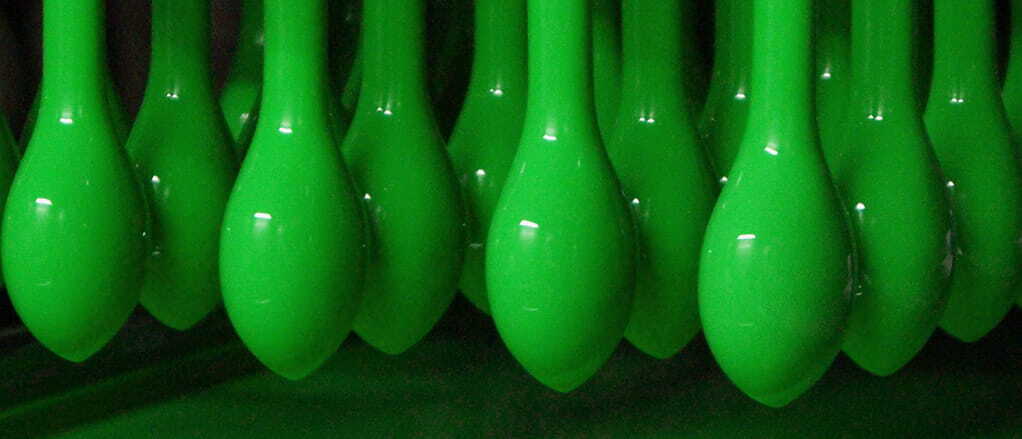
A balloon is a thin-walled product. Its shape is created by forming a latex film on a suitable former. Different methods are used to create this layer when manufacturing dipped products. Two terms found in technical literature are straight dipping and coagulant dipping. These methods primarily concern how latex is deposited on the former. They should not automatically be equated with “budget” and “premium” product categories.Straight dipping – direct immersion
In straight dipping, the former is immersed directly in the latex compound without first applying a coagulant layer. The amount of material deposited depends on factors including the properties and viscosity of the compound, contact time and the parameters of the dipping process itself. This technique can be used for products that require a very thin layer. However, the name of the process alone does not indicate the quality of the finished product.Coagulant dipping – dipping with a coagulant
In coagulant dipping, the former is coated with a coagulant before it comes into contact with the latex compound. When the former is immersed, a layer of latex gel forms on its surface. Film thickness and formation can be affected by:- the type and concentration of the coagulant,
- the properties of the latex compound,
- contact time,
- process temperature,
- how the dipping process is carried out.
Straight dipping vs coagulant dipping – what is the difference?
| Feature | Straight dipping | Coagulant dipping |
|---|---|---|
| Former preparation | No coagulant layer is applied beforehand | The former is coated with a coagulant beforehand |
| Film formation | Latex is deposited directly during dipping | The coagulant causes a latex gel layer to form on the former’s surface |
| Thickness control | Depends on factors including compound properties and dipping parameters | Depends on factors including the coagulant, latex compound and dipping parameters |
| Typical manufacturing applications | Very thin latex products | Widely used for various dipped products, including balloons and gloves |
| Does the method alone determine product quality? | No | No |
UV, oxygen and temperature – how does latex age?
Natural rubber, like other elastomers, can change its properties over time under the influence of environmental factors. Relevant factors may include:- UV radiation,
- contact with oxygen and ozone,
- prolonged exposure to elevated temperatures,
- exposure time,
- the degree to which the material is stretched.
Bursting vs air or helium loss – what is the difference?
A sudden burst and gradual gas loss are two different phenomena. Bursting involves the rapid rupture of a stressed membrane. By contrast, a balloon gradually shrinking may be caused by gas passing through the material or a small leak.| Phenomenon | What happens? |
|---|---|
| Bursting | The membrane ruptures suddenly |
| Gradual gas loss | The balloon gradually decreases in volume without suddenly rupturing |
How can you reduce the risk of balloons bursting accidentally?
It is impossible to guarantee that an inflated balloon will never burst. However, you can reduce some of the factors that increase the risk of accidental damage.- Do not exceed the recommended balloon size. Overstretching increases the load on the thin membrane.
- Check the installation area. Remove or cover sharp edges, rough components and areas against which balloons may repeatedly rub.
- Be careful with jewellery and tools. Minor mechanical damage can become the starting point of a tear.
- Avoid unnecessary exposure to intense sunlight and excessive heat. Prolonged exposure to environmental factors can affect the material’s properties.
- Store uninflated balloons correctly. The condition of the product before inflation also affects its subsequent performance.
- Have spare balloons ready for larger projects. An inflated balloon remains a thin, stretched product, so occasional damage during transport or installation can happen.
What role does the balloon manufacturing process play?
The properties of a finished balloon do not come from a single production stage. Relevant factors include:- preparation of the latex compound,
- the method used to form the latex film,
- vulcanisation process parameters,
- subsequent processing stages,
- inspection of the finished product.
FAQ – frequently asked questions
Why can a balloon burst without being touched?
The cause is not always visible at the moment of bursting. Minor surface damage, local weakening of the material or excessive stress may have developed earlier. This area can become the starting point of a tear.
Does an overinflated balloon burst more easily?
Overinflation stretches the balloon wall further. This is why you should not exceed the recommended size for the particular balloon model.
Does vulcanisation affect a balloon’s resistance to damage?
Yes. Vulcanisation affects the structure and mechanical properties of rubber. However, it is not the only factor determining how a finished balloon behaves. The compound formulation, latex film formation and other manufacturing parameters also matter.
Does a higher degree of vulcanisation always increase strength?
No. An elastomer’s properties depend on an appropriately selected crosslinking system and degree of crosslinking. Greater crosslink density can change various material properties, but it does not automatically produce a proportional increase in resistance to rupture.
Is a thicker balloon always more resistant to bursting?
The resistance of the whole product cannot be assessed solely from its wall thickness. Material properties, membrane uniformity, balloon geometry, inflation method and conditions of use also matter.
Can sunlight affect latex balloons?
Yes. Prolonged exposure to UV radiation, oxygen, ozone and elevated temperatures can change the properties of natural rubber over time. The extent of these changes depends on the product and exposure conditions.
Does helium loss mean that a balloon is damaged?
Not always. Gas can gradually pass through the balloon material, so a decrease in volume is not the same as a sudden rupture of the membrane.
How can you reduce accidental balloon bursting while decorating?
Do not exceed the recommended balloon size, avoid sharp and rough surfaces, take care with jewellery and tools, limit unnecessary exposure to intense sunlight, and store uninflated balloons according to the manufacturer’s recommendations.