Balloon Printing Techniques & Machines

Printing on a balloon requires a different approach from printing on paper or textiles. A balloon is a curved, flexible surface that changes during inflation. The machine must therefore do more than apply ink: it must also inflate, stabilise and position the balloon correctly in relation to the design.
When producing custom printed balloons, important factors include the printing method, number of colours, balloon positioning, registration of successive layers of artwork and inspection of the finished print. This article explains how balloon printing works and which parts of the process influence the result.
Why Are Balloons a Challenging Surface to Print On?
Printing on a balloon differs from printing artwork on a flat, rigid surface. This is primarily due to the properties of the balloon itself.
- The balloon’s surface is curved. The design must be transferred onto a surface whose angle varies, making correct positioning relative to the printing screen particularly important.
- The balloon is flexible. Its surface deforms under pressure and stretches during inflation, and the print changes size with it.
- Balloon diameter affects the print. During production, the balloon is inflated with air to a specified diameter. Keeping this consistent helps maintain similar print placement and dimensions across the balloons.
- Multicolour printing requires precise positioning. Successive elements of the artwork must align correctly with the previously printed layers.
This is why balloon printing machines must combine ink application with control over the position and inflation of the flexible surface.
How Does a Balloon Printing Machine Work?
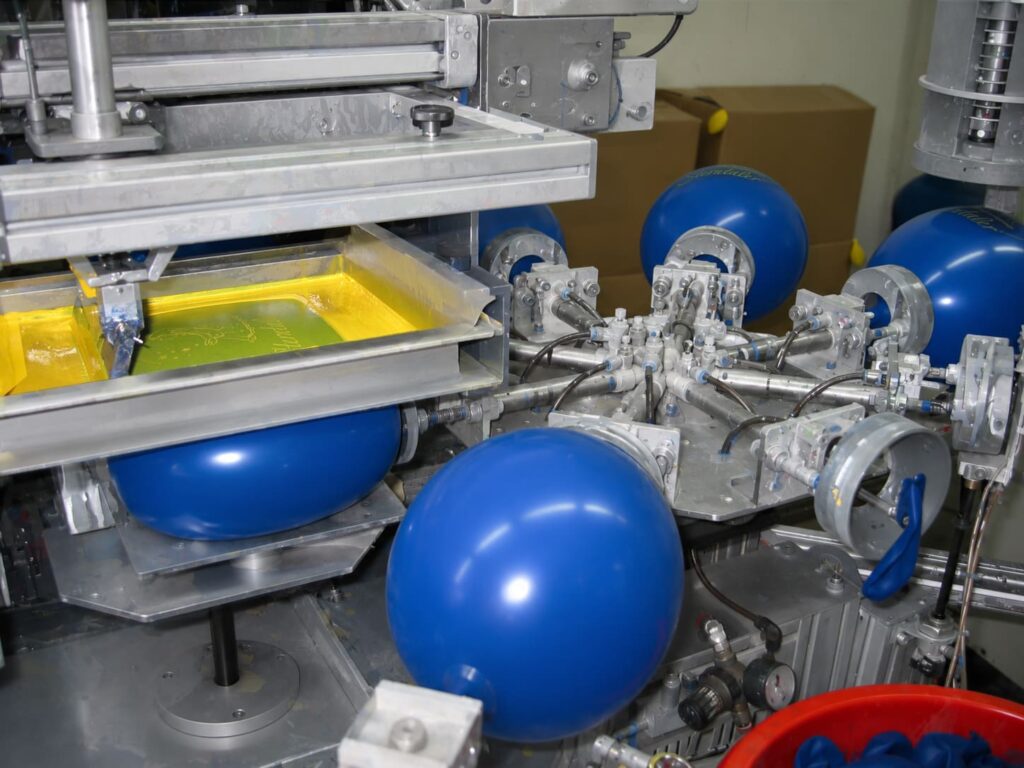
A balloon printing machine uses several components that work together throughout the printing process. First, the balloon is inflated to the required size and positioned for printing. The prepared artwork is then applied to its surface using screen printing.
The process uses:
- an inflation system – inflates the balloon to the required working diameter,
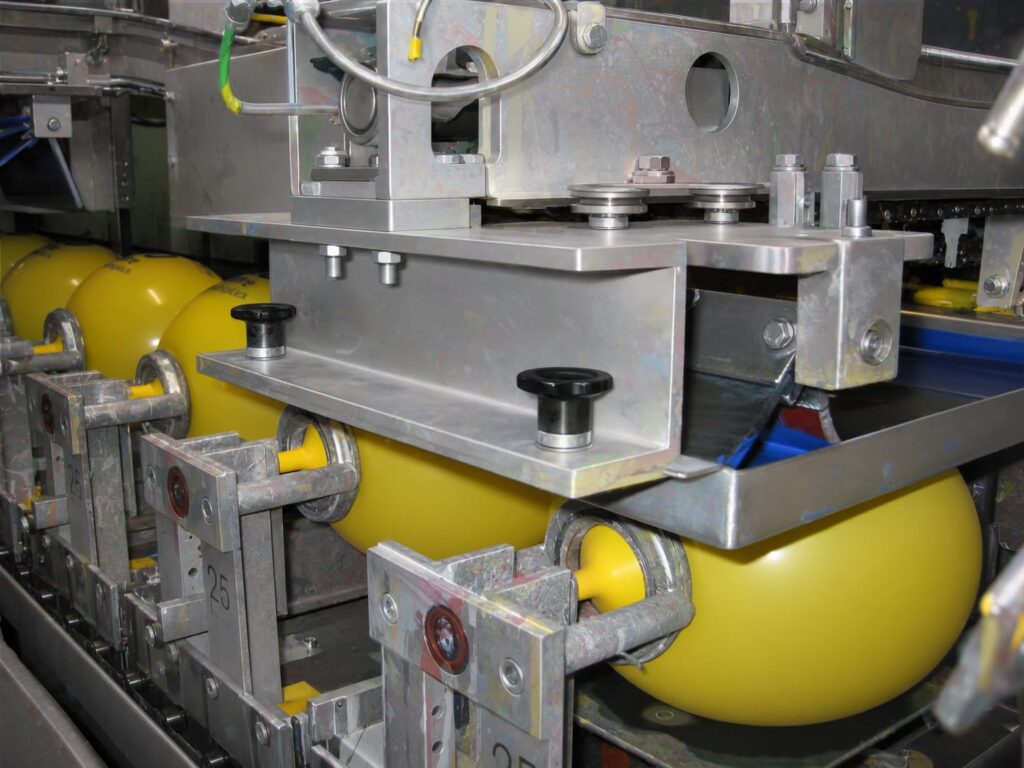
- a positioning station – holds the balloon in the correct position during printing,
- a screen carrying the prepared design – transfers a specific part of the artwork onto the balloon,
- a squeegee – moves ink across the screen and pushes it through the design onto the balloon’s surface,
- additional printing stations – enable multicolour printing or printing in different positions on the balloon,
- a drying stage – prepares the printed balloon for subsequent production and packing stages.
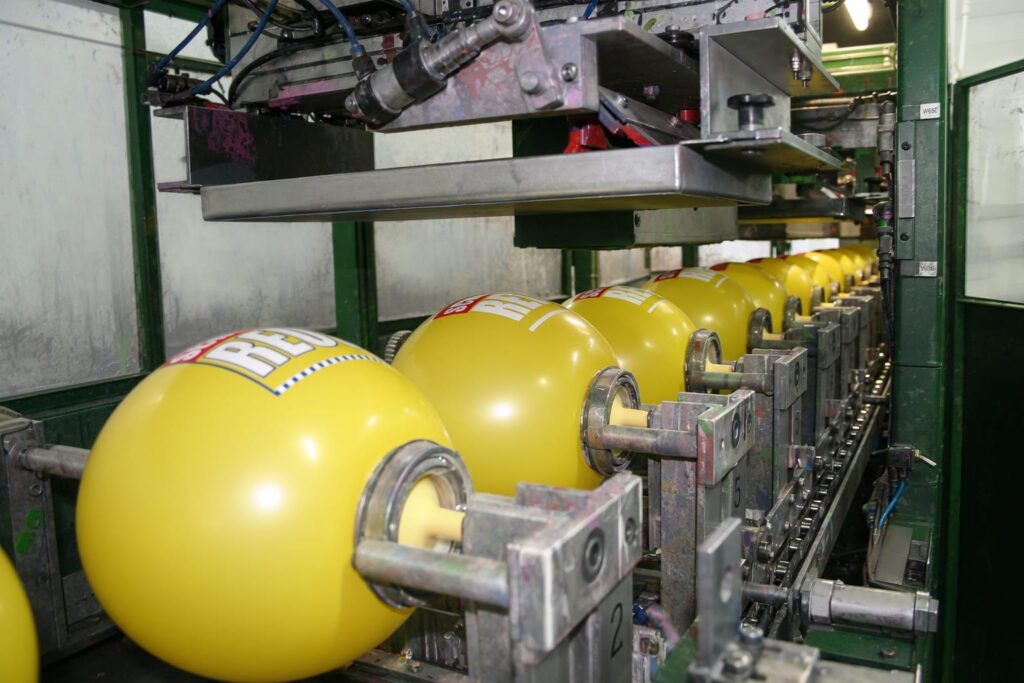
The production line may vary depending on the type of print, but the operating principle remains similar. The balloon must be positioned correctly, and successive elements of the artwork must be applied in a defined sequence. This allows consistent prints to be produced across a series of balloons.
How Does Screen Printing on Balloons Work?
Screen printing is one of the main methods we use to print on latex balloons. In this process, ink is transferred onto the balloon’s surface through a specially prepared screen.
First, we prepare the artwork and assess its suitability for the production method. For conventional multicolour screen printing, the individual colours in the design must be separated. A screen is then prepared for each print layer, carrying the corresponding part of the design. Each additional colour requires a separate printing stage.
The balloon is inflated with air to a specified working diameter and positioned in the machine. Consistent inflation helps maintain similar print placement throughout the production run.
A squeegee moves ink across the screen. The ink passes through the open areas of the prepared design and is deposited directly onto the balloon’s surface.
If the design uses more than one colour, the next layer must be aligned with the artwork already printed. This stage requires accurate colour registration.
After application, the ink is allowed to dry and set before the balloon is deflated and passed on to the next production stages.
What Is Colour Registration?
Colour registration means precisely aligning successive print layers with one another. It is particularly important for artwork containing several colours. For example, if a logo contains three colours, each element must appear exactly where the design requires it. Even a slight misalignment can be visible where two colours meet or in small details of the logo. On a flat material, controlling the position of successive layers is easier. With balloons, the flexibility and curvature of the surface create an additional challenge, making a consistent working diameter and stable positioning important. Because the surface is flexible, slight shifts between colours may occur in multicolour prints. These are described in terms of registration tolerance.Which Printing Methods Do We Use at Everts-Pol?
The printing method depends on the number of colours, the structure of the artwork and the area to be printed. The main options currently offered by Everts-Pol are screen printing, multicolour printing (Laserprint/CMYK) and 360° printing (all-around printing).| Printing Method | Capabilities | Print Coverage | Minimum Order Quantity |
|---|---|---|---|
| Screen printing | Up to 8 colours | One side, or up to 4 colours on each side | Single-colour printing from 100 balloons; requirements for more complex prints depend on the design |
| Multicolour printing | Up to 8 colours + a maximum of 1 colour on the reverse | Main print area + optional printing on the back of the balloon | From 1,000 balloons |
| 360° printing | 1 colour | Printing around the balloon’s circumference | From 1,000 balloons |
How Are Multicolour Balloon Prints Produced?
Multicolour printing allows more complex designs to be reproduced than a simple single-colour logo. Depending on the artwork, it may use separate areas of solid colour or a specially prepared halftone pattern. Halftone printing uses very small dots or image elements to reproduce variations in brightness and colour. A properly prepared halftone print can reproduce tonal gradients, shading and photographic-style designs. For artwork using CMYK printing, the ability to reproduce the design successfully depends on factors including its level of detail, print size and the colour of the balloon itself. These files are therefore checked before production begins. Not every multicolour design requires halftones. A logo made up of several solid colours may require different preparation from artwork containing tonal gradients.How Does 360° Balloon Printing Work?
The main difference between 360° printing and standard single-sided printing is the extent of the printed area. With the 360° method used by Everts-Pol, the print is applied in one colour around the balloon’s circumference. This creates artwork that can be seen from multiple directions. This option can be useful when balloons are displayed in open spaces and may change position relative to the viewer. However, not every design is suitable for 360° printing. The artwork must be prepared with its placement on the curved surface in mind.Which Balloons Can Be Printed?
The range of balloons suitable for printing is narrower than Everts-Pol’s full range of decorative balloons.| Format | Printing Characteristics |
|---|---|
| 10″ – approx. 23 cm | A smaller print area, well suited to simple, clearly legible designs. |
| 11″ – approx. 27 cm | Provides a larger print area than the 10″ format. |
| 12″ – approx. 30 cm | The larger surface provides space to display a logo, lettering or more elaborate artwork. |
| 18″ – approx. 45 cm | The largest of the listed latex balloon sizes, available for single-colour printing. |
| Heart-shaped balloons and punch balloons | Their distinctive shapes require the print coverage and placement to be adapted to the specific design. |
What Affects Print Quality?
The final result depends on more than the machine itself. Artwork, balloon positioning, colours and consistency throughout the process also matter.- Contrast between the balloon and the print – contrast has a major effect on legibility. If the ink colour is very similar to the balloon colour, the logo or lettering may be less visible. Light colours that provide sufficient contrast are usually easier to see on a dark background, and vice versa.
- Artwork complexity – designs containing very thin lines, small text or fine details may need adjustment before being transferred onto the balloon’s flexible surface. Simplifying the design can also reduce the number of print colours required, affecting the printing method and production preparation.
- File preparation – for standard printing, vector artwork with all text converted to outlines is preferred. However, the detailed requirements depend on the artwork and the selected printing method.
- Consistent working diameter – each balloon should be inflated consistently during printing. Changes in diameter affect surface tension and, in turn, the size and placement of the applied artwork.
- Registration of successive layers – multicolour printing requires the individual elements of the artwork to remain correctly aligned. The more complex the design, the more important precise alignment becomes at each printing stage.