How to Choose a Balloon Wholesaler: B2B Guide | Everts-Pol

Are you planning a balloon garland or wall and wondering how many balloons to prepare? There is no universal calculation that works for every decoration. The number of balloons required depends primarily on the length or surface area of the decoration, balloon sizes, inflation levels, arrangement density and installation method.
Below, you will find approximate quantities, ready-to-use tables and simple formulas to help you plan your order.
Important: the figures in this guide apply to the specific types of structures described below. Treat them as a practical starting point rather than a universal standard for every decoration.
Balloon garlands and walls of this type are made with air-filled balloons. Helium is not required because the balloons are attached to garland tape, a grid, a frame or another structure.
To learn more about these arrangements, see our guide to balloon decorations without helium.
Key information:
- How many balloons do you need for a garland or wall?
- How many balloons do you need per metre of garland?
- Which balloon sizes should you use in a garland?
- How do you calculate quantities for double-stuffed balloons?
- How many balloons do you need for a balloon wall?
- How to calculate the number of balloons you need
- Which balloons should you choose for a garland or wall?
- How to prepare your order
- How to calculate balloon quantities for multiple decorations
- FAQ – Frequently asked questions
How many balloons do you need? The quick answer
For a quick estimate, allow:- a dense organic garland: approximately 30–40 balloons per metre,
- a less dense garland: approximately 20–25 balloons per metre,
- a densely packed, single-layer wall made with 5″ balloons: approximately 55–65 balloons per m²,
- a wall made with a mixture of balloon sizes: approximately 35–45 balloons per m².
How do you measure the length of a garland?
Measure the entire route that the finished garland will follow. If the decoration surrounds an entrance, include not only its width but also the sides, top, curves and bends. Example: If the garland runs vertically for 2 m, then extends 1.5 m above the entrance and continues for another 2 m down the other side, its total length is approximately 5.5 m, rather than 1.5 m.How do you calculate quantities for double-stuffed balloons?
The double-stuffing technique involves placing one balloon inside another. This means that one visible element of the decoration actually uses two individual balloons. Example: You are preparing a garland with 100 visible balloons. If you want to make 20 of these elements using the double-stuffing technique, you will need: 100 base balloons + 20 additional balloons = 120 balloons. Always add the balloons used for the second layer separately to your basic requirements.How many balloons do you need for a balloon wall?
The number of balloons required for a wall depends primarily on:- the surface area of the decoration,
- how the structure is built,
- balloon sizes,
- the density of the arrangement,
- the number of different sizes used.
| Wall dimensions | Surface area | Dense coverage with 5″ balloons | Mix of 5″ / 10″ / 12″ balloons |
|---|---|---|---|
| 1 × 2 m | 2 m² | 110–130 balloons | 70–90 balloons |
| 1.5 × 2 m | 3 m² | 165–195 balloons | 105–135 balloons |
| 2 × 2 m | 4 m² | 220–260 balloons | 140–180 balloons |
Important: a balloon wall versus a photo backdrop with a garland
Not every “wall with balloons” requires the entire surface to be covered with balloons. If you are using a ready-made panel, photo backdrop, fabric backdrop or another solid structure and decorating only the side or top with a garland, calculate balloon quantities according to the length of the garland, rather than the surface area of the entire backdrop. For example, a 2 × 2 m panel decorated with a 3-metre garland requires a very different number of balloons from a full 2 × 2 m wall made entirely from balloons.How many balloons do you need per m² of balloon wall?
For the structure described above, allow approximately:- 55–65 balloons measuring 5″ per m²,
- 35–45 balloons per m² when using a mixture of sizes.
How many balloons do you need for a 2 × 2 m balloon wall?
A wall measuring 2 × 2 m has a surface area of 4 m². As a guide, prepare:- approximately 220–260 balloons measuring 5″ for dense coverage,
- approximately 140–180 balloons when using a mixture of 5″, 10″ and 12″ sizes.
How to calculate the number of balloons you need
If your decoration’s dimensions are not listed in the table, you can use a simple formula.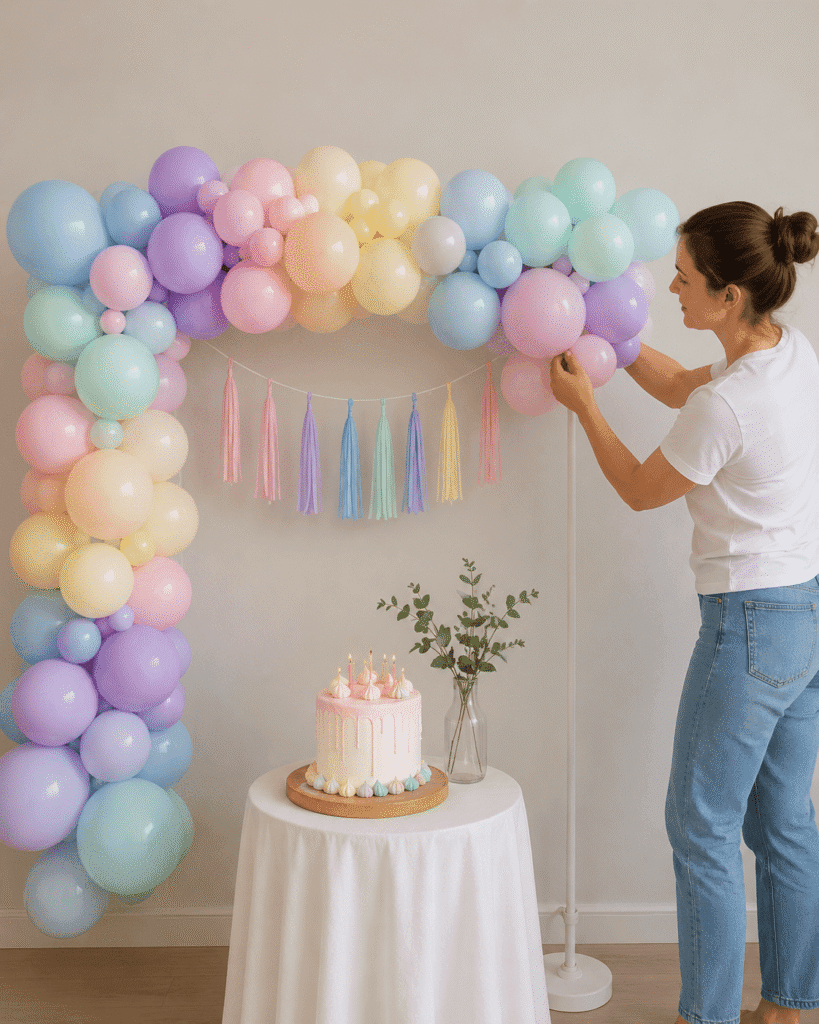
Approximately 100 balloons were used to create this decoration.
Balloon garland
For a dense organic garland, use the following estimate: garland length in metres × 30–40 balloons For a quick calculation, use an average of approximately 35 balloons per metre.Example: a 2.5-metre garland
2.5 × 30 = approximately 75 balloons 2.5 × 35 = approximately 88 balloons 2.5 × 40 = approximately 100 balloons Depending on the planned density, prepare approximately 75–100 balloons, then add an allowance for spares.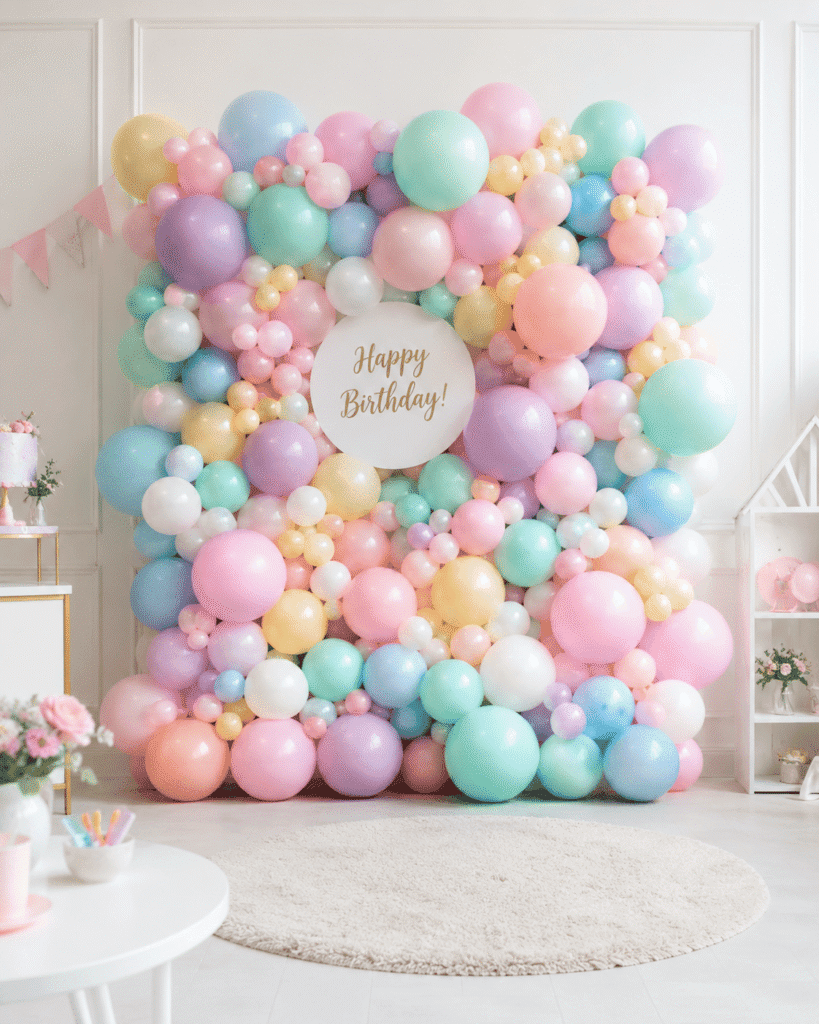
Approximately 300 balloons were used to create this decoration.
Balloon wall
First, calculate the surface area: width in metres × height in metres = surface area in m² For a densely packed wall made with 5″ balloons, use the following estimate: surface area in m² × 55–65 balloons For a quick calculation, use an average of approximately 60 balloons per m².Example: a 1.2 × 2.2 m balloon wall
1.2 × 2.2 = 2.64 m² 2.64 × 60 = approximately 158 balloons Finally, add approximately 10–15% extra for spares.
Choose latex balloons suited to your planned structure and the size of its individual elements.
When planning a balloon garland or wall, consider the following points.
Combining several sizes
A mixture of balloon sizes allows you to create a more varied arrangement. Larger balloons form the main structure, while smaller ones can fill the gaps.Using one size
If you want a more regular, consistent layout, you can use one main balloon size.Double stuffing
Placing one balloon inside another allows you to create additional colour variations. However, each double-stuffed element uses two balloons, so account for this when planning your order.Colour palette
You can use several shades from one colour family or combine a dominant colour with contrasting accents. Before ordering, establish both the total balloon quantity and the breakdown by colour and size.Installation accessories
Depending on the structure, you may need:- balloon garland tape,
- a balloon pump,
- fixings,
- a suitable frame or grid.
Shopping list – how to prepare your order
Before buying balloons, work through these seven steps.1. Measure the decoration
For a garland, measure the entire route it will follow. For a full balloon wall, measure the width and height.2. Choose the arrangement style
Decide whether the decoration will be less dense or have a dense, organic arrangement.3. Estimate the number of balloons
Use the tables or formulas provided in this guide.4. Break down the quantities by size and colour
Determine how many larger balloons you need for the main structure and how many smaller ones you need to fill the gaps.5. Add the extra balloons needed for double stuffing
If part of the decoration will use double-stuffed balloons, count each additional inner balloon as a separate balloon.6. Add approximately 10–15% extra for spares
Spare balloons can be useful during installation, for filling gaps and for adjusting the arrangement.7. Prepare your accessories
Check that you have garland tape, a balloon pump and all the components needed to secure your chosen structure.How to calculate balloon quantities for multiple decorations
If you are preparing several garlands or balloon walls for one event, calculate the requirements for each decoration separately. Then:- add up the total number of balloons required,
- break the quantity down by size,
- break it down by colour,
- add the extra balloons needed for double stuffing,
- add your planned allowance for spares.