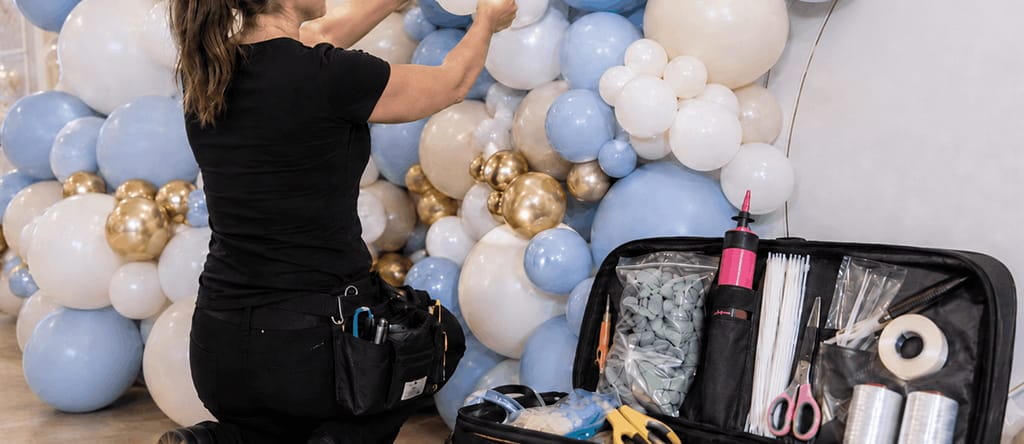
What should a balloon decorator’s emergency kit contain?
Minor damage, displaced elements or fixing problems can occur when installing a decoration. A basic
balloon decorator’s emergency kit helps you make the necessary adjustments quickly.
Before leaving for an installation, check the following:
| Category |
What to bring |
What it can help with |
| Spare balloons |
Colours and sizes used in the design |
Replacing damaged balloons and filling out the arrangement |
| Inflation |
An electric balloon pump and a hand pump |
Inflating replacement balloons; the hand pump can serve as a backup |
| Connecting balloons |
Garland tape, fishing line and string |
Joining and adjusting sections of the decoration |
| Securing the decoration |
Cable ties and fixings suitable for the structure and mounting surface |
Adjusting and securing attachment points |
| Minor adjustments |
Glue dots designed for balloon decorations |
Attaching lightweight elements and filling small gaps |
| Tools |
Scissors, work gloves and tools needed for the structure being used |
Preparing and adjusting installation components |
| Power supply |
An extension lead if you are using electrical equipment |
Powering a pump or other equipment during installation |
| Working at height |
A suitable, stable ladder or work platform |
Installing elements beyond safe reach from ground level |
Why prepare an emergency kit?
Even a carefully prepared decoration may need adjustments during transport, installation or the event itself. For professional projects, keep a
balloon decorator’s emergency kit ready.
It can help you quickly:
- replace a damaged balloon,
- fill a gap in a garland,
- adjust a small section of the arrangement,
- secure a loose element,
- restore the intended layout after transport.
Store the kit in a box with a lid or a compartment organiser. Sort balloons, installation accessories and tools by purpose so you can quickly find what you need.
For larger projects, check the kit against a standard checklist before leaving.
How many spare balloons should you take to an installation?
Bring extra
latex balloons in the same colours and sizes used in the design.
Prioritise spares for:
- the decoration’s dominant colours,
- balloons forming the main structure,
- the most frequently used sizes,
- small balloons used to fill gaps,
- elements in the most visible parts of the decoration.
As a practical starting point, allow approximately
10–15% more balloons than the design requires. The actual quantity depends on the decoration’s size, installation method and type of project.
You do not need an equal number of spares for every colour. Allow more extras for the colours and sizes that dominate the arrangement.
Sort spare balloons by colour and size. This makes it easier to find a replacement that matches the rest of the decoration.
To estimate your total balloon requirements, also see our guide:
how many balloons you need for a garland or balloon wall.
How to choose tools and accessories
Different tools serve different types of repairs. Above all, distinguish between
structural components and accessories intended only for minor visual adjustments.
Structural problems
If a larger section of the garland has shifted, or the problem involves the frame, support line or main attachment point, inspect and stabilise the structure first.
These adjustments may require suitable support lines, string, cable ties or other fixings appropriate to the specific structure.
Minor decorative adjustments
Glue dots can help with lightweight, local adjustments, such as attaching a small balloon to fill a gap. However, they should not replace the structure’s main fixings.
Not every adhesive or self-adhesive material is suitable for contact with latex or every mounting surface. Use accessories designed for balloon decorations and previously tested with the materials you are using.
If an element is attached directly to a wall, glass, wood, wallpaper or another surface, also check that the fixing is suitable for that surface and will not damage it.
Explore Everts-Pol balloon accessories.
How to repair a balloon decoration quickly
Before making an adjustment, establish whether the problem involves:
- a single balloon,
- a small part of the arrangement,
- a larger section of the garland,
- the main fixing or structure.
For most minor adjustments, follow this sequence:
- Inspect the structure. Check the frame, support lines and main attachment points.
- Remove the damaged element. If a balloon has burst, collect all its fragments.
- Prepare a replacement. Choose a balloon in the appropriate colour and size.
- Inflate it to the correct size. Match it to the neighbouring elements.
- Attach the balloon. Use a fixing method appropriate to the structure.
- Check the entire arrangement from a distance. Assess its shape, proportions and colour distribution.
What should you do when a balloon bursts?
Replace a burst balloon with a new one in the same colour and size, or as close a match as possible.
- Remove the remains of the burst balloon.
- Prepare a new balloon.
- Inflate it to a size that matches the neighbouring elements.
- Attach it where the damaged balloon was, or fill the resulting gap with a suitable element.
- View the decoration from a distance.
Important: collect fragments of burst balloons and remove them from the event area, particularly where young children could access them.
What should you do when a balloon loses air?
If a single balloon is visibly losing air, replacing it is usually more practical than trying to repair the balloon itself.
Prepare a new balloon in the appropriate colour and size, match its inflation level to the neighbouring elements and replace the damaged balloon.
If the same problem occurs in several places at once, also check whether the cause is related to the construction method or the conditions surrounding the decoration.
How to fill a gap in a balloon garland
If a small gap appears after a balloon bursts or shifts, you do not always need to rebuild a larger section of the garland.
In organic decorations, you can often fill the space with one or more smaller balloons in colours that suit the arrangement.
After making the adjustment, step back and check that the new element does not create an overly prominent cluster of one colour or size.
What should you do if part of a garland shifts?
If a larger part of the decoration has shifted, do not start by adding more balloons.
First, check:
- the main attachment points,
- the lines or strings supporting the decoration,
- the connection between the garland and frame,
- whether a structural component has loosened or changed position.
Adjust the balloon arrangement only after stabilising the structure.
What should you do if a decoration’s fixing fails?
If the problem involves a main attachment point, the priority is
structural stability, rather than the decoration’s appearance.
- Support the affected section so it does not place additional load on the remaining attachment points.
- Check why the component came loose.
- Assess the structure and the surface to which the decoration is attached.
- Use a fixing method suitable for the structure and mounting surface.
- Reposition the balloons once the decoration is stable.
Do not replace a structural component with an unsuitable tape or adhesive simply because it is available. The fixing method should suit the decoration, load and mounting surface.
What should you check after installation or repair?
Once the work is complete, carry out a brief structural and visual inspection.
Structural inspection
- check the stability of the structure,
- inspect the main attachment points,
- make sure no section of the garland is loose,
- check that installation components are correctly positioned,
- remove burst balloon fragments and leftover installation materials.
Visual inspection
- check the distribution of colours and sizes,
- look for visible gaps,
- check that installation components are not overly visible,
- view the decoration from several metres away,
- check its appearance from the guests’ viewing position,
- check the view from the planned photography position.
What should you check after transporting a decoration?
If part of the decoration was prepared in advance and transported to the venue, check the following before final installation:
- whether any balloons have burst,
- whether visible gaps have appeared,
- whether sections of the arrangement have shifted,
- whether structural components or fixings have loosened during transport.
Should you leave the organiser a kit for minor adjustments?
For some projects, you can leave the organiser a small kit intended solely for simple cosmetic adjustments.
For example, it may contain:
- a few spare balloons in the main colours and sizes,
- a small number of glue dots for lightweight elements,
- brief instructions explaining which adjustments can be made without altering the structure.
This kit should not be used to repair the frame, main attachment points or components affecting the stability of the entire decoration. If the problem is structural, the repair should be carried out by someone familiar with how the decoration was installed.
FAQ – Frequently asked questions
What should a balloon decorator’s emergency kit contain?
A basic kit should include spare balloons in the colours and sizes used, a hand pump and an electric pump if needed, garland tape, fishing line or string, suitable fixings, glue dots for minor adjustments, scissors and any other tools required for the structure.
How many spare balloons should you take to an installation?
As a practical starting point, prepare approximately
10–15% more balloons than the design requires. Allow more spares for the colours and sizes that dominate the decoration.
What should you do when a balloon bursts in a garland?
Remove the damaged balloon’s fragments, prepare a replacement in the appropriate colour and size, inflate it to match the neighbouring balloons and attach it using the garland’s existing construction method.
What can you use to fill a small gap in a garland?
In an organic garland, a small gap can often be filled with one or more smaller balloons. Match their colour and size to the neighbouring elements.
What should you do when a balloon starts losing air?
If a single balloon is visibly losing air, replacing it is usually the best option. This helps restore the decoration’s intended appearance more quickly.
How do you attach a new balloon to a finished decoration?
The attachment method depends on the structure. You can insert the balloon into the garland tape or secure it using the existing joining method. Glue dots designed for balloon decorations can help with lightweight, local adjustments. However, they should not replace structural components.
What should you do if a larger section of the garland has shifted?
First, inspect the main attachment points and the structure. Adjust the individual balloons only after stabilising them.
What should you do if a decoration’s fixing fails?
First, support the decoration and inspect the structure and mounting surface. Then use a fixing method suitable for both. Simply rearranging the balloons is not enough.
Are glue dots enough to repair a garland?
Glue dots are primarily suitable for minor adjustments and attaching lightweight elements. If a larger section of the garland or a main attachment point has loosened, stabilise the structure first.
What should you do with fragments of a burst balloon?
Collect them immediately after the balloon bursts and remove them from the event area. This is particularly important where young children could access them.
What should you check before leaving the installation site?
Check structural stability, main attachment points, balloon placement, the visibility of installation components and the decoration’s appearance from the guests’ viewing and photography positions. Also make sure no burst balloon fragments or leftover installation materials remain near the decoration.